Start with the weather, not the stain
If a leak appears only in hard rain, especially rain driven by wind, I would look first at junctions and laps rather than assume there is a hole directly above the mark. Water can get behind a flashing, under a slate edge or into a valley and then track along timber before dropping.
After steady vertical rain, a different set of faults becomes more likely. Overflowing gutters, blocked outlets and flat-roof defects are easier to spot when you know what the weather was doing at the time.
Older slate roofs can hide a simple fault
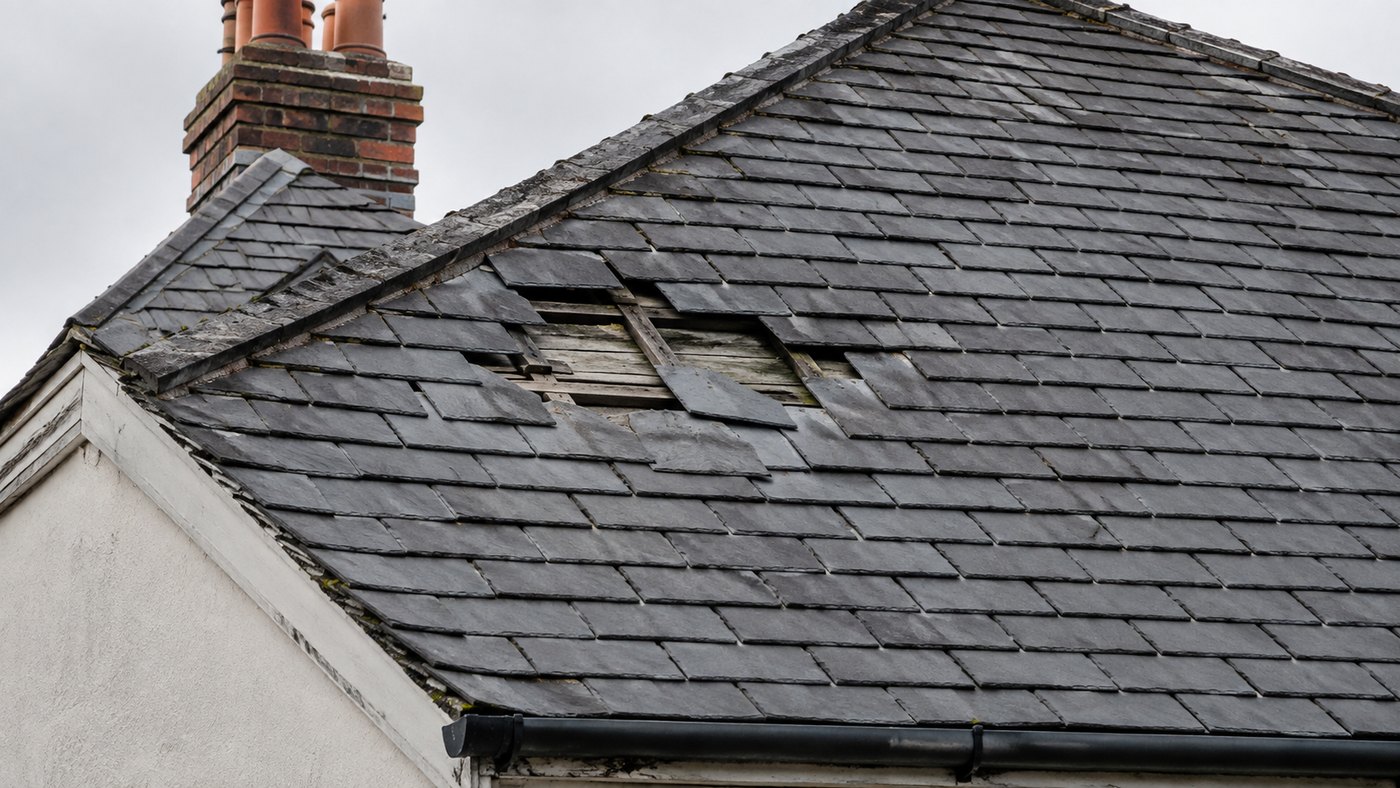
Oldham has plenty of older terraced and semi-detached houses with slate roofs. One slipped slate may be enough to let water in. The awkward part is that the visible gap is not always obvious from the ground, particularly if the slate has only moved an inch or two.
On a roof that has been repaired several times, I also look for previous patches. A neat-looking dab of sealant can hide a fixing problem rather than cure it.
Chimneys and valleys deserve a close look
Water marks near a chimney breast often point people straight at the chimney. Sometimes that is right. Sometimes the leak is from the valley alongside it, a split in the lead, a cracked fillet or even a gutter higher up the slope.
Valleys carry a lot of water in a short time. A small obstruction or lifted edge can matter more there than it would on the open roof.
What I would want checked
A useful inspection should follow the likely water route. That normally means checking the outside covering, the junctions, the underside of the roof where accessible, and the condition of nearby gutters and flashings. Looking only at the damp patch from inside is not enough.
Water can travel a fair distance before it shows indoors, so the route needs checking before the repair is decided.